
Stabilizing glucocerebrosidase (GCase) for Gaucher disease gene therapy
Updated: Mar 25

Scala’s underlying technology enabled thermostable, long-lived enzyme variants that improve survival and brain function in neuronopathic Gaucher disease
Why it matters
Lysosomal storage disorders are often caused by unstable or short-lived enzymes that fail to persist in the body. In neuronopathic Gaucher disease, the lysosomal enzyme glucocerebrosidase (GCase) is defective, and both enzyme replacement and gene therapy attempts have been limited by instability and poor distribution in the brain. Independent academic studies have shown that stability design can transform fragile enzymes into robust variants that fold more efficiently, persist longer, and restore function in disease models.
Problem
Conventional gene therapy for Gaucher disease uses the wild-type GCase sequence, which is unstable and fails to rescue neuronal disease phenotypes. Treated mice typically survive only ~16 weeks, with rapid weight loss, impaired motor function, and neuroinflammation. Without improved stability, gene therapy cannot meaningfully alter disease progression in the brain.
What was done
Using Scala’s stability design approach, researchers generated stabilized GCase variants in a single round, carrying 35–72 mutations each. The lead design showed higher stability, broader expression, and stronger enzymatic activity than the wild-type or clinically used GCase (Cerezyme®). It was tested both in cellular assays and in a chronic neuronopathic Gaucher mouse model via AAV delivery.
Results
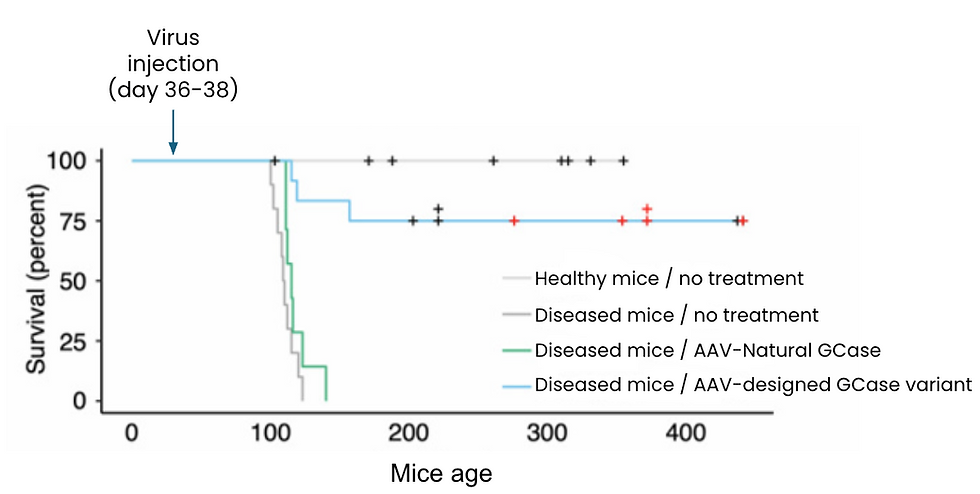
Therapeutic effect: stabilized GCase extended survival to 35–72 weeks, restored motor function, and cleared brain lipid buildup.
Stability: +17 °C higher melting temperature than the clinical enzyme.
Expression: active and secreted in E. coli, unlike the wild type.
Impact
By stabilizing GCase, researchers overcame a bottleneck that had limited the efficacy of gene therapy in neuronopathic Gaucher disease. The results show that Scala’s stability design platform can produce enzymes that persist longer in the brain, achieve greater biochemical correction, and extend survival. Beyond Gaucher disease, Scala’s ability to design stable enzymes demonstrates the broad potential of stability design for protein replacement therapies in lysosomal storage disorders and other genetic diseases.
Data highlights
Kaplan–Meier survival curves:
AAV–stabilized GCase extended lifespan from ~16 weeks to 35–72 weeks.
Thermal stability curve showing ~+17 °C increase in melting temperature over the clinical enzyme.

Measured activity after E.coli expression: stabilized enzyme secreted and active, unlike wild type.

References
Milenkovic, I., Blumenreich, S., Hochfelder, A., Azulay, A., Biton, I. E., Zerbib, M., Oren, R., Tsoory, M., Joseph, T., Fleishman, S. J., & Futerman, A. H. (2024). Efficacy of an AAV vector encoding a thermostable form of glucocerebrosidase in alleviating symptoms in a Gaucher disease mouse model. Gene Therapy, 31, 439–444. https://doi.org/10.1038/s41434-024-00476-8
Pokorná, S., Khersonsky, O., Lipsh-Sokolik, R., Goldenzweig, A., Nielsen, R., Ashani, Y., Peleg, Y., Unger, T., Albeck, S., Dym, O., Tirosh, A., Tarayra, R., Hocquemiller, M., Laufer, R., Ben-Dor, S., Silman, I., Sussman, J. L., Fleishman, S. J., & Futerman, A. H. (2023). Design of a stable human acid-β-glucosidase: towards improved Gaucher disease therapy and mutation classification. The FEBS Journal, 290(13), 3383–3399. https://doi.org/10.1111/febs.16758


